Dumbbell Bent-Over Row
Why it matters
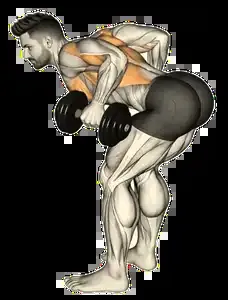
The Bent-Over Row builds strength and size in your upper back, biceps, latissimus dorsi and rear deltoids. As a compound movement, it trains several muscles together and carries over to real-world strength and power.
How to do it
- Choose a pair you can control for every planned rep and get them into position cleanly.
- Hinge at the hips until your torso is close to parallel with the floor.
- Set your torso and let your working arm hang with the shoulder blade relaxed forward.
- Set a stable base before you begin pulling.
- Pull your elbow back toward your hip, leading with the elbow.
- Draw the load to your lower ribs and squeeze your shoulder blade back.
- Lower under control until your arm is straight and the shoulder blade reaches forward.
Coaching cues
- Hold the hinge still for the whole set — your torso should not rise as you pull.
- Lead with your elbow, not your hand.
- Draw the load toward your belt line rather than your chest.
- Let your shoulder blade slide back and down at the top of each rep.
- Pull with your back and squeeze your shoulder blades together, not just your arms.
Watch out for
-
Standing up out of the hinge as the set gets hard.
This takes work off the target muscle and reduces what you get from the set.
Instead Pick a spot on the floor ahead of you and keep your eyes there.
-
Yanking with the lower back and using momentum.
Yanking uses your back and momentum instead of the muscles you are rowing with.
Instead Keep your torso still and let your arm and shoulder blade do the work.
-
Shrugging the shoulder up toward the ear while pulling.
A shrugging shoulder takes the pull off your back and into your traps.
Instead Keep your shoulder down and pull your elbow straight back.
-
Cutting the stretch short at the bottom.
Skipping the stretch removes the part of the range that builds the most.
Instead Let your arm fully straighten and your shoulder blade reach forward before the next rep.
The detail
- Tempo
- Pull with intent, then lower for about two counts.
- Breathing
- Exhale as you pull, breathe in as you return under control.
- Range of motion
- Reach into a full stretch at the bottom and pull until your shoulder blade is fully retracted. Take the upper back through its full working range each rep.
- Setting up
- Choose a pair you can control for every planned rep and get them into position cleanly.
- If you are new to it
- Use a load you can pull without leaning back or jerking.
- Once it is easy
- Pause and squeeze for one count at the fully retracted position.
Safety
- Reduce the load if you lose control of the movement.
- Stop the set if you feel sharp pain.