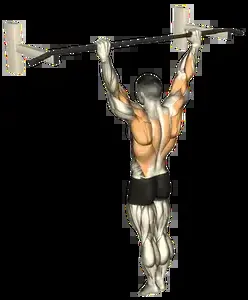
Archer Pull-Up
Why it matters
The Archer Pull-Up builds strength and size in your latissimus dorsi, biceps and upper back. As a compound movement, it trains several muscles together and carries over to real-world strength and power.
How to do it
- Set your hands wider than normal so one arm straightens as the other bends.
- Set your grip and start from a full hang or fully stretched position.
- Set your shoulders down away from your ears before the first rep.
- Drive your elbows down toward your hips.
- Pull until your chest reaches your hands.
- Lower under control back to a full stretch.
- Complete all your reps on one side, then repeat with the other, matching the reps on your weaker side.
Coaching cues
- The straight arm is a kickstand, not a pusher — the bending side does the work.
- Drive your elbows down toward your hips to lead the pull.
- Pull your chest up to your hands rather than leading with your chin.
- Start every rep from a full stretch at the top.
- Drive your elbows down and back to pull from your lats.
Watch out for
-
Sharing the load evenly between both arms.
This takes work off the target muscle and reduces what you get from the set.
Instead Shift your weight over the working side until the straight arm feels light.
-
Kipping or swinging to complete the rep.
Swinging uses momentum instead of your back and arms, so the pull does less.
Instead Pull from a dead hang and keep your body quiet.
-
Stopping the pull the moment your chin clears your hands.
Stopping at the chin trains a shorter range and less of your back.
Instead Pull until your collarbone or chest reaches your hands.
-
Failing to reach a full stretch between reps.
Without the full stretch you train a shorter range and build less.
Instead Let your arms straighten fully and your shoulder blades rise at the top.
The detail
- Tempo
- Pull with intent, then lower for about two to three counts.
- Breathing
- Exhale as you pull up, breathe in as you lower under control.
- Range of motion
- Travel from a full hang to your hands at your chest every rep. Take the latissimus dorsi through its full working range each rep.
- If you are new to it
- Use assistance or a resistance band to complete full-range reps.
- Once it is easy
- Add a pause at the top with your chest to your hands before lowering.
Safety
- Reduce the load if you lose control of the movement.
- Stop the set if you feel sharp pain.