Side Plank
Why it matters
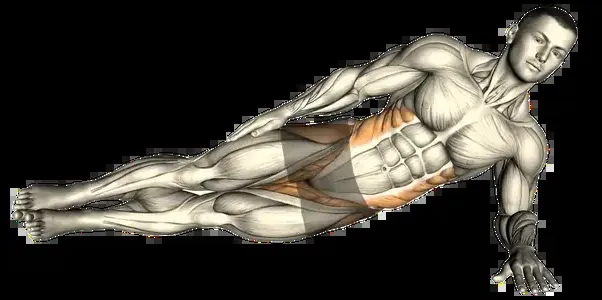
The Side Plank builds strength and size in your rectus abdominis, hip flexors and obliques. As a compound movement, it trains several muscles together and carries over to real-world strength and power.
How to do it
- Lie on your side and stack your elbow directly under your shoulder.
- Set your position and take the slack out of your midsection before you begin.
- Start each rep from a controlled, stable position.
- Move slowly and deliberately through the working range.
- Pause briefly where your midsection is working hardest.
- Control the return rather than dropping quickly at the end.
- Lift your hips until your body forms a straight line from head to heels, and hold.
Coaching cues
- Push the floor away with your bottom elbow to keep your shoulder from sinking.
- Move under control — no yanking or rushing the reps.
- Curl your ribs toward your hips rather than pulling with your neck.
- Keep the tension on your midsection, not your hip flexors or lower back.
- Curl your ribs toward your hips and feel your abs shorten.
Watch out for
-
Rolling the top hip forward or back.
This takes work off the target muscle and reduces what you get from the set.
Instead Keep both hips stacked vertically as if pressed between two walls.
-
Pulling on the neck or head to complete the rep.
Pulling your head does the work your abs should, so your midsection gets less out of it.
Instead Keep your hands light and lead the movement from your midsection.
-
Rushing through reps with momentum.
Momentum does the work your abs should, so the set does less.
Instead Slow each rep down and control both directions.
-
Arching the lower back away from a braced position.
A loose lower back leaks force and takes the work off your abs.
Instead Keep your ribs down and your midsection tight through the whole rep.
The detail
- Tempo
- Move slowly in both directions and avoid using momentum.
- Breathing
- Exhale as you contract, breathe in as you return.
- Range of motion
- Work through a range you can control without your lower back taking over. Take the rectus abdominis through its full working range each rep.
- If you are new to it
- Reduce the range or leverage until you can control every rep.
- Once it is easy
- Add a pause at the hardest point of the range for extra tension.