Foam Roll Lats
Why it matters
The Foam Roll Lats helps you move more freely through the positions your training demands.
How to do it
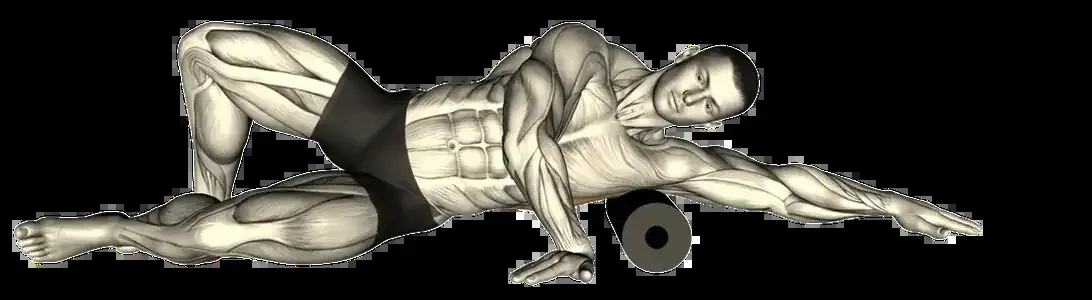
- Place the roller or ball under the target area and support your weight with your hands.
- Ease into the starting position without forcing the range.
- Set a comfortable position you can control before moving.
- Move to the first point of tension, not into pain.
- Ease slightly deeper on each exhale.
- Hold the end position briefly, then return smoothly to the start.
- Roll slowly, pausing for a few breaths on any spot that feels tight.
Coaching cues
- Slow is the whole point — fast rolling passes over the tissue you are trying to reach.
- Move to the first point of tension rather than into pain.
- Breathe out as you ease a little deeper into the range.
- Move smoothly and slowly rather than bouncing.
- Own the full range of every rep before you add reps or make it harder.
Watch out for
-
Rolling quickly back and forth over the area.
This takes work off the target muscle and reduces what you get from the set.
Instead Cover an inch at a time and pause where it is tender.
-
Forcing or bouncing into an end range.
Forcing past your range fights the stretch instead of easing it and does little for mobility.
Instead Move slowly to gentle tension and let it ease with your breath.
-
Holding your breath while you hold the position.
Holding your breath tenses you up and stops you easing deeper into the range.
Instead Keep breathing slowly and let each exhale ease you a little deeper.
-
Snapping quickly from one rep to the next.
Snapping through reps skips the controlled range that mobility work depends on.
Instead Move slowly into and out of each repetition.
The detail
- Tempo
- Move slowly and hold positions rather than bouncing.
- Breathing
- Breathe slowly and use each exhale to relax a little deeper.
- Range of motion
- Work to a comfortable end range that eases over the set.
- If you are new to it
- Reduce the range and build gradually session to session.
- Once it is easy
- Add a gentle contraction at end range before relaxing deeper.