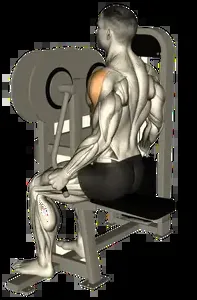
Machine Lateral Raise
Why it matters
The Lateral Raise builds strength and size in your lateral deltoids. As an isolation movement, it targets those muscles directly to build size and balance.
How to do it
- Adjust the seat and any pads so the working joint lines up with the machine’s pivot, set the pin to your working weight, and keep contact with the support pad throughout.
- Set a tall torso with a slight bend in your elbows.
- Start with the load under control at your sides or front.
- Lead with your elbows and raise the load to shoulder height.
- Pause briefly at the top.
- Lower the load under control to the start.
Coaching cues
- Lead with your elbow and stop around shoulder height.
- Lead with your elbows and stop at shoulder height.
- Keep a soft, fixed bend in your elbows throughout.
- Lower under control rather than dropping the load.
- Lead with your elbow and feel the side of your shoulder do the work.
Watch out for
-
Swinging the weight up with a hip drive.
This takes work off the target muscle and reduces what you get from the set.
Instead Slow it down and let the shoulder raise the weight on its own.
-
Swinging the load up with the torso.
Body swing does the lifting, so your shoulders get little out of it.
Instead Keep your torso still and raise the load with your shoulders, not momentum.
-
Raising the load well above shoulder height and shrugging.
Going too high brings your traps in and takes the work off the muscle you want.
Instead Stop at shoulder height and keep your traps relaxed.
-
Letting the wrists roll or drop under the load.
Bent wrists leak force and move the effort away from the muscle you want.
Instead Keep your wrists flat and level with your forearms throughout.
-
Letting the weight stack slam down at the bottom.
A slammed stack means gravity did the lowering, not your muscles.
Instead Control the return so the plates settle without banging.
The detail
- Tempo
- Raise with control and lower for about two counts.
- Breathing
- Exhale as you raise, breathe in as you lower.
- Range of motion
- Raise to shoulder height and lower to a light stretch at the start. Take the lateral deltoids through its full working range each rep.
- Setting up
- Adjust the seat and any pads so the working joint lines up with the machine’s pivot, set the pin to your working weight, and keep contact with the support pad throughout.
- If you are new to it
- Use a light load and stop the moment your form breaks down.
- Once it is easy
- Add a pause at shoulder height before lowering.