Hurdle Jump
Why it matters
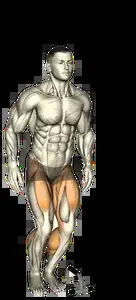
The Hurdle Jump builds strength and size in your glutes, adductors, erector spinae and rectus abdominis. As a compound movement, it trains several muscles together and carries over to real-world strength and power.
How to do it
- Set a box height you can land on comfortably and make sure it is stable and won’t slide.
- Set your feet about hip-width with the load close to your shins.
- Set your back flat and take a breath into your belly before you pull.
- Push your hips back and let your knees bend slightly as the load lowers.
- Keep the load brushing your legs the whole way.
- Stand up by driving your hips forward until you are tall.
- Move as fast as you can on the way up while staying in control.
Coaching cues
- Intent is the point — every rep should be maximally fast, and the set ends when speed drops.
- Push your hips back until you feel a stretch in your hamstrings.
- Keep the load in contact with your legs from start to finish.
- Finish by squeezing your glutes, not by leaning back past standing.
- Squeeze your glutes hard at the top of each rep.
Watch out for
-
Grinding out slow reps once fatigue sets in.
This takes work off the target muscle and reduces what you get from the set.
Instead End the set the moment bar or body speed visibly slows.
-
Rounding the lower back as the load leaves the floor.
A rounded back is the weakest position to lift from.
Instead Set your back flat and lift your chest before the load moves.
-
Turning the hinge into a squat by bending the knees too early.
Early knee bend takes the stretch and work off your hamstrings and glutes.
Instead Send your hips backward first and let the knees follow.
-
Hyperextending and leaning back at the top.
Leaning back past standing loads your lower back and adds nothing to the lift.
Instead Stop when you are standing tall with your glutes squeezed.
The detail
- Tempo
- Lower for about two to three counts, then drive up with intent.
- Breathing
- Breathe in at the top, brace, hold through the lift, then exhale once you are standing.
- Range of motion
- Lower until you feel a hamstring stretch with a flat back — depth is limited by your hamstrings, not the floor. Take the glutes through its full working range each rep.
- Setting up
- Set a box height you can land on comfortably and make sure it is stable and won’t slide.
- If you are new to it
- Practice the hip hinge with a light load or dowel to groove the pattern first.
- Once it is easy
- Pause just below the knee to build control in the stretched position.