Back Extension
Why it matters
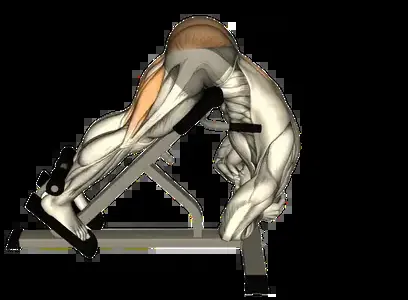
The Back Extension builds strength and size in your erector spinae. As a compound movement, it trains several muscles together and carries over to real-world strength and power.
How to do it
- Set your position so your torso can move from a forward bend to a straight line with your body.
- Set a flat back and brace your midsection before the first rep.
- Raise your torso by extending your hips and lower back until your body forms a straight line.
- Squeeze your glutes at the top without arching past a straight line.
- Lower under control back to the start.
Coaching cues
- Move by extending your hips and back, not by swinging.
- Stop at a straight line — don’t arch past it.
- Control the lowering phase on the way back down.
- Brace your spine and lengthen through your back as you extend.
- Own the full range of every rep before you add reps or make it harder.
Watch out for
-
Over-arching and hyperextending at the top.
Arching past a straight line loads your spine and adds nothing to the movement.
Instead Stop when your body reaches a straight line and hold briefly.
-
Using momentum to swing the torso up.
Swinging up uses momentum instead of your back and glutes.
Instead Raise under control by extending your hips and back.
-
Rounding the back on the way down instead of controlling it.
A rounded, uncontrolled lower puts your spine in a weak position under load.
Instead Lower under control and keep your back set.
The detail
- Tempo
- Raise with control and lower for about two counts.
- Breathing
- Exhale as you raise your torso, breathe in as you lower.
- Range of motion
- Move from a comfortable forward bend to a straight-line torso, without arching past it. Take the erector spinae through its full working range each rep.
- If you are new to it
- Start with bodyweight and a short range until you can control the movement.
- Once it is easy
- Add a pause at the top or a light load once you own the bodyweight movement.